

I keep noticing something odd about innovation funding.
Actually, to be a little more specific. It's fucked.
Last year, venture capital firms invested $300 billion globally. Fair enough. But here's what caught my attention: AI companies alone captured 45 per cent of all startup funding in the United States. $135 billion flowing into artificial intelligence.
Meanwhile, meditation and wellness startups raised roughly $150 million across the entire sector.
Do the maths. For every dollar invested in consciousness expansion, nine hundred flows to technological acceleration.
Nine hundred to one.
Now, that's not the interesting bit. The interesting bit is why this split exists at all.
Because when you dig into it, you discover something brilliant: there's an algorithm running that's been deciding which types of velocity get resources and which get resistance.
And it's been running for over a century.
The Pattern That Started Everything
Let me tell you about two crashes that happened decades apart but reveal the same recognition.
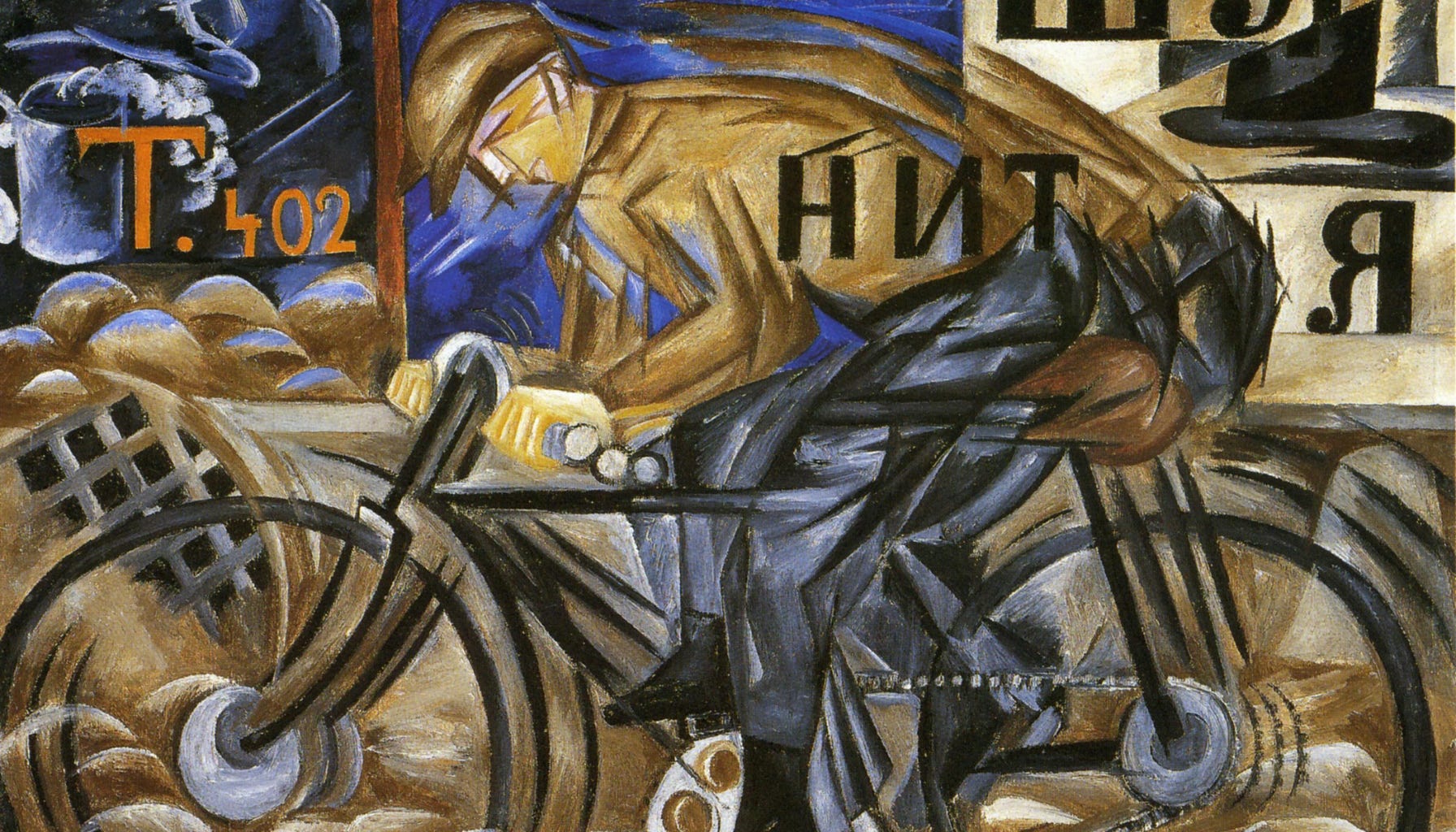
Milan, October 1908. Filippo Tommaso Marinetti crashes his Fiat into a ditch. Crawls out covered in mud. In that moment of violent acceleration, he discovers "the beauty of speed."
Four months later, he publishes the Futurist Manifesto: "A racing car whose hood is adorned with great pipes, like serpents of explosive breath is more beautiful than the Victory of Samothrace!"
Fast forward.
America, 1947. Neal Cassady grips the wheel of a '49 Hudson. Foot pressed to the floor. Jack Kerouac riding shotgun. They're not just driving across the continent. They're using velocity to escape every constraint society's placed on consciousness itself.
Two men who understood the same thing: speed isn't just movement. It's philosophy.
But here's what's fascinating.
The system decided which type of velocity would get resources.
And which would get resistance.
The Algorithm Nobody Talks About
What happened next reveals something extraordinary about how power selects which movements to fund.
Marinetti gets absorbed into Mussolini's Fasci Italiani di Combattimento, making him one of the first members of the National Fascist Party. His velocity worship becomes a tool of state power.
Mind you, Marinetti's manifesto declared war on museums and libraries. Proclaimed that "Poetry must be conceived as a violent attack on unknown forces, to reduce and prostrate them before man."
This was velocity in service of domination.
Meanwhile, Cassady's taking a different path. Kerouac credits him with discovering "Spontaneous Prose": all first person, fast, mad, confessional. Stunning.
But the state responds differently to this type of velocity.
Allen Ginsberg, the Beat poet, comes to FBI attention in 1963. By 1965, the Bureau's investigating whether he's "engaged in any activities which would be considered inimical to the interests of the U.S."
The pattern becomes crystal clear.
Velocity serving power gets funded.
Velocity threatening power gets surveilled.
It's not random.
It's algorithmic.
The Cross-Domain Recognition
Now here's where this gets interesting.
Consider the slime mould Physarum polycephalum. Japanese researchers placed oat flakes in positions corresponding to cities around Tokyo. The brainless organism created a network connecting the food sources that looked remarkably like the existing rail system.
No central planning. No intelligence to guide its moves.
Yet it creates networks with "comparable cost, efficiency and tolerance for faults" to human design.
But here's the crucial bit: the slime mould's optimising for survival, not control.
Jazz improvisation reveals the same principle. John Coltrane drew mathematical diagrams showing the geometric relationships in his compositions. But when Ornette Coleman removed chord changes entirely, the music remained coherent through emergent self-organisation.
Same recognition: complex systems self-organise toward optimal patterns.
Different applications: control versus liberation.
The Modern Implementation
Recent analysis of more than six-hundred medical startups revealed something brilliant: "communicating disruptiveness decreases funding" from independent VCs, whilst corporate VCs show more interest.
Translation?
The system's learned to sort disruption by allegiance.
Consider the funding patterns.
Marinetti-Style Acceleration includes surveillance capitalism platforms extracting behavioural data, AI systems optimising human productivity for corporate efficiency, and "disruption" that creates new monopolies whilst preserving power structures.
Cassady-Style Acceleration involves consciousness expansion technologies, community organising platforms, and "disruption" that empowers individuals against institutional control.
The venture capital ecosystem's evolved into what I'd call a quantitative hygiene system.
It cleanses the market of velocity movements that challenge existing hierarchies.
Right then.
What's really happening here?
The Algorithm Goes Visible
Actually, hang on. What's happening right now makes this pattern impossible to ignore.
Trump's administration has frozen $11 billion in research funding. Harvard alone lost $450 million. California researchers have lost $273 million in NIH grants.
But here's what's fascinating: it's not random. The cuts target specific types of research: climate change, LGBTQ communities, racial inequities in health, vaccine hesitancy.
Meanwhile, defence research at Johns Hopkins that focuses on "missile design, submarine technology and precision tracking systems" isn't getting cut.
Same mechanism. Different scale. Crystal clear execution.
We're watching the Marinetti-Cassady split play out in real time. University research that serves power structures continues. Research that might redistribute power gets defunded.
It’s Mussolini getting stacked, Kerouac getting handcuffed.
The algorithm that started with surveillance of Beat poets now operates at unprecedented scale and transparency.
The Consciousness Suppression Mechanism
The pattern runs deeper than funding. It's about cultural programming that makes certain types of acceleration invisible.
Critics label the mindfulness industry "McMindfulness," claiming that "a ten-minute, app-assisted meditation strays incredibly far from the original intent."
Notice what's happening.
The system allows consciousness technologies to exist, but only when stripped of transformative power.
Only when commodified into productivity tools.
Liberation becomes efficiency.
Awakening becomes optimisation.
Meanwhile, technological acceleration gets completely different treatment. Modern tech idealism promises "disruption," "innovation at all costs," "unlocking potential."
Pure Marinetti.
Velocity as conquest.
The Three Hundred Billion Dollar Question
Which brings us to the acceleration paradox.
AI funding represents the ultimate expression of Marinetti-style velocity. OpenAI capturing the lion's share. We're building systems that could make human decision-making obsolete.
Including decisions about which types of acceleration to fund.
But here's the twist.
AI might be the first technology that forces confrontation with the casualties of velocity worship.
Every previous acceleration could be contained. Factory pollution affected specific communities. Financial "disruption" hit targeted industries.
AI's different.
Universal.
Existential.
For the first time, the people designing the acceleration might become its casualties.
This changes everything.
Note to Self
Every funding decision's a vote for the future you want.
For over a century, we've been voting for Marinetti's vision: velocity as conquest. Acceleration as extraction. Speed in service of whoever can afford to direct it.
The results speak for themselves.
Meanwhile, the Cassady approach has been systematically defunded by an algorithm that evolved to protect existing power structures.
But AI changes everything.
You can't optimise your way out of an optimisation problem created by optimisation.
The three hundred billion flowing into artificial intelligence annually represents the biggest bet in human history. We're betting we can control systems more intelligent than ourselves.
We're betting Marinetti's algorithm can contain forces that make Marinetti's imagination look quaint.
Pattern seers have been watching this convergence for years. Trump's university cuts aren't political aberration. They're the algorithm going visible.
The velocity trap's closing.
The question isn't whether we'll be disrupted.
The question's whether disruption will finally disrupt itself.
Because for the first time in history, the disruptors might discover they're the disrupted.
Wake up.
The pattern's right there.
The choice has always been simple: velocity that serves power, or velocity that threatens it.
Now it's unavoidable.
Oh, now I see why Zoroaster catches your attention, or is it rather Nietsche's Zarathustra who was allowed to prosper, setting out to overcome the analysis ot that very dualism who made his name know (yet not too famous) over the centuries.